
AI in 2026: The Reality Check
Why the Wait-and-See Approach Just Became a Liability
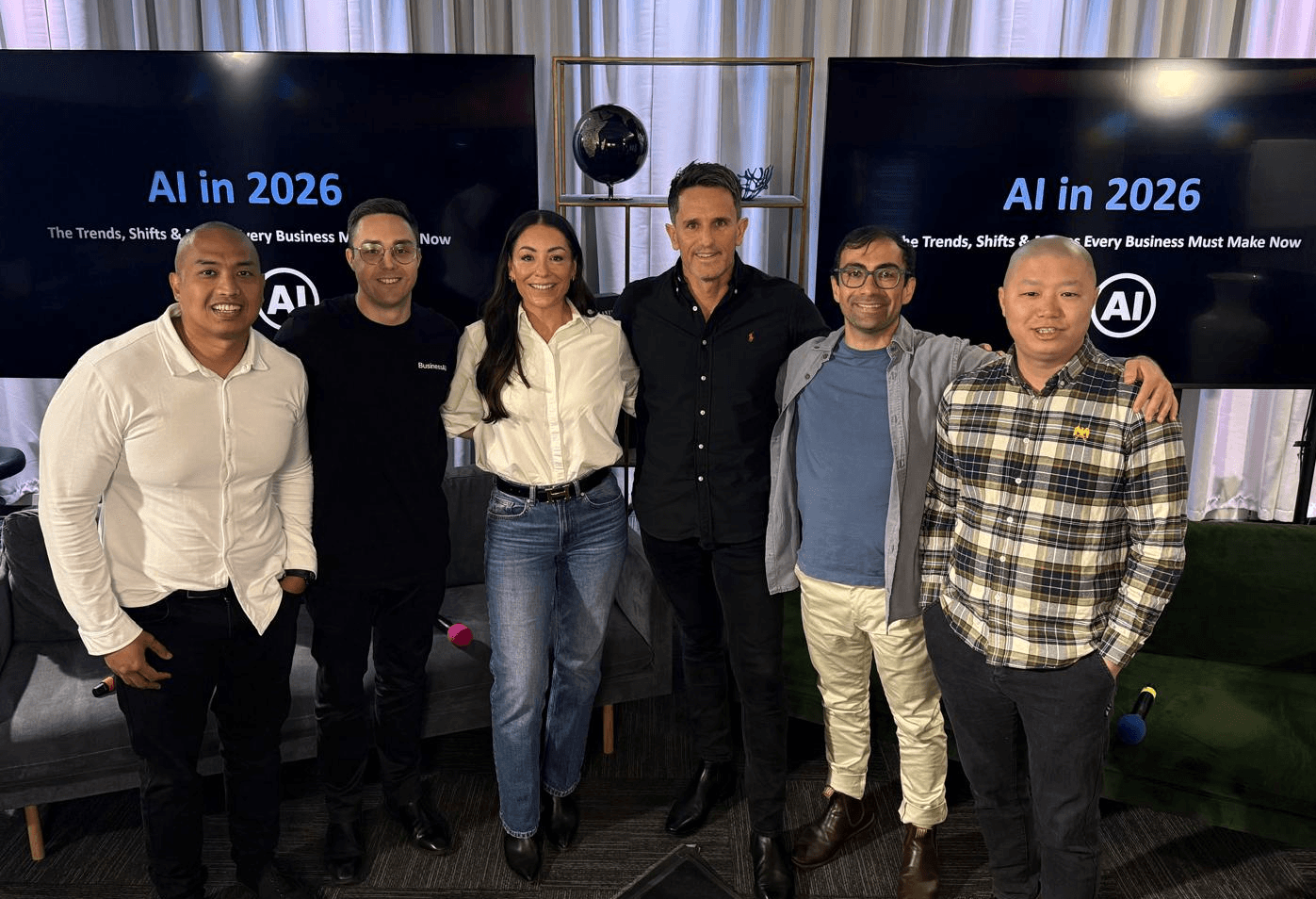
Last week, we hosted our end-of-year customer webinar, bringing together our team and our Group VP of People at Sansoni Management, Charlotte Hall, to reflect on what 2025 taught us about AI adoption and what businesses need to do differently in 2026.
It was a practical, no-nonsense conversation about what's changing and why it matters.
Because here's what we're seeing: 2025 was the last year you could afford to "wait and see" with AI.
The World Has Already Shifted
On the surface, AI seems to be moving fast. Josh, our Venture Associate, took us through how, beneath the surface, something bigger has happened. The world has already shifted, and many business leaders are only now realising it.
Consider these signals:
AI is no longer a tool; it's becoming the default layer in software. Everything from CRMs to email platforms to customer service systems now has AI woven into it. If your internal processes feel slow, it's not because AI hasn't arrived. It's because the workflows around it haven't been updated.
Speed and quality have both doubled in the last 12 months. AI responses are faster. Output is more accurate. Model costs have dropped. The barrier to doing meaningful things with AI is lower than it's ever been.
Instant response has become a customer expectation. People aren't waiting 24 hours for replies anymore. They expect answers now, on whatever channel they prefer. If your communications are slow or manual, customers feel it immediately.
Younger demographics avoid phone calls altogether. They live on WhatsApp, Messenger, SMS, and social DMs. If your business relies heavily on phone or email-based workflows, you're already out of sync with how the next generation buys and communicates.
Administration-heavy businesses are being squeezed. Hiring is harder. Wages are higher. Administration roles are disappearing. And AI handles repetitive work instantly, without dropping the ball.
When we say the world has already shifted, we mean it literally. Your competitors aren't becoming better businesses; they're becoming faster ones. And speed is now more critical than ever as a competitive advantage.
The Economics Have Changed Beneath Us
During the webinar, Mark, Head of Strategy & Growth, shared something that stopped the conversation cold: the economic reality behind AI adoption isn't about technology anymore. It's about survival math.
Labour is more expensive. Administration staffing shortages are real. Turnover is high. Entry-level roles are evaporating. People don't want repetitive work, and AI does it instantly and consistently.
If you're still trying to scale with humans alone, you're competing against businesses that have a full digital workforce working 24/7.
That's not a scare tactic. That's just the new competitive landscape.
What We Learned in 2025
Our CTO, Avarile, and Head of Product, Arsedian, shared some hard truths from working with dozens of businesses this year.
The winners moved early and with simplicity. The best results came from small, boring workflows such as follow-up automation, quoting systems, customer communication, and reporting. Nothing flashy. Just effective.
But more than half of the businesses we spoke with had no strategy. They wanted AI, but they didn't know what problem they were solving. The biggest failures came from over-engineering, trying to boil the ocean instead of starting with one workflow that mattered.
AI doesn't fail. Poor scoping does.
And here's the opportunity: if you haven't started, you're already behind, but you can still catch up fast if you start small and start now.
The Seven Workflows Every Business Needs to Automate in 2026
We asked our team: if a business could only automate a handful of things in 2026, what should they be?
Here's the must-do list:
1 - Lead Qualification - Know who's worth your time before you spend it
2 - Follow-Up - Never let a lead go cold because someone forgot to reply
3 - Sales Administration - Stop letting quotes and proposals slow your pipeline.
4 - Customer Support - Give instant answers without burning out your team
5 - Knowledge Base - Make your company's expertise accessible 24/7
6 - Reporting - Get insights without drowning in spreadsheets
7 - Marketing Content - Stay consistent without hiring an army
If you don't automate these, your competitors will. And they'll use the time and margin they save to outpace you.
The People Reality: Why AI Projects Die Before They Begin
This is where Charlotte Hall brought the conversation to life.
Because here's what nobody talks about enough: technology adoption fails when we ignore the human side.
Charlotte identified six critical challenges every leader needs to manage:
Staff Fear
People hear "AI" and immediately think job loss, being replaced, losing relevance, and not being good enough anymore. When leaders stay silent or vague, fear fills the gap with worst-case stories.
The solution? Say the quiet part out loud early and clearly. Explain what AI will change and what it won't change. Reframe AI as a support tool, not a replacement. Share real examples of roles being elevated, not removed. And let leaders go first by visibly learning themselves.
As Charlotte put it: "When leaders name the fear, it shrinks. When they ignore it, it grows."
Capability Gaps
AI is moving faster than most training programs. People are expected to adapt without feeling properly equipped, which creates resistance, overwhelm, and avoidance.
Break learning into short, role-specific sessions. Appoint internal AI champions. Protect learning time during work hours. Reward effort at the start, not just outcomes.
"You cannot expect confidence without competence."
Adoption Patterns
Every team has different personalities, risk appetites, and change tolerance. Some people love trying new tools. Others need proof. And a few actively resist.
Use early adopters as internal case studies. Support the cautious middle with peer examples. Listen to resistors rather than forcing compliance. Set minimum expectations without demanding perfection.
"Not everyone crosses the bridge at the same time, but leadership decides how safe that bridge feels."
Ghost Projects
Most AI tools are implemented by leadership or IT, then handed to teams without a clear behaviour owner. Without ongoing accountability, excitement fades and usage stops.
Assign one clear owner for adoption. Build AI usage into daily workflows and KPIs. Review adoption weekly for the first 90 days. Measure usage, not just license cost.
"If no one owns behaviour change, the project already has an expiry date."
Micro Changes Beat Big Transformations
Large-scale change creates overwhelm. When people feel overwhelmed by tools, pressure, and expectations, they freeze rather than move.
Start with one workflow and one pain point. Pilot in one team before scaling. Track time saved and celebrate it. Stack small wins into larger momentum.
"Momentum is built in inches, not leaps."
Communication and Trust During Transition
Many businesses communicate change to teams rather than with them. When communication is one-way, people feel done to, not walked with.
Explain the why before the tool. Involve teams early in testing and feedback. Keep communication two-way. Celebrate progress publicly. Course-correct openly when needed.
"Change fails when communication is vague and wins when it is human."
Charlotte's closing line captured everything: "AI succeeds in business when leaders manage fear before systems, capability before speed, behaviour before tools, and trust before targets."
Where to Go from Here
We've covered the trends, shifts, and realities within businesses. So, the natural question is: where do you go from here?
At BusinessAI, we help businesses progress through three simple steps:
Educate - understand what's possible
Strategy - identify the highest-value opportunities
Implement - put practical AI into the business to unlock speed, margin, and capacity.
The businesses that made the most progress in 2025 didn't try to transform overnight. They took the next logical step that moved them forward.
Some went big, building AI directly into their core operation: straight-through lending, real-time quoting, automated estimation. Others started with simple tasks: automating follow-ups, streamlining customer communications, and eliminating reporting bottlenecks.
Both paths work. Standing still doesn't.
The Hard Truth
The gap between businesses that started and those that didn't is about to explode.
If you're not building AI capability right now, you won't necessarily fail today. But by 2027, you'll be competing against businesses with a digital workforce that works 24/7.
This isn't fear. This is reality.
And the good news is: if you haven't started yet, there's still time to catch up quickly.
You can go big or start simple, but you don't need to transform the whole business.
Just take the next step that moves you forward.
Rhys Henderson
CEO, BusinessAI
